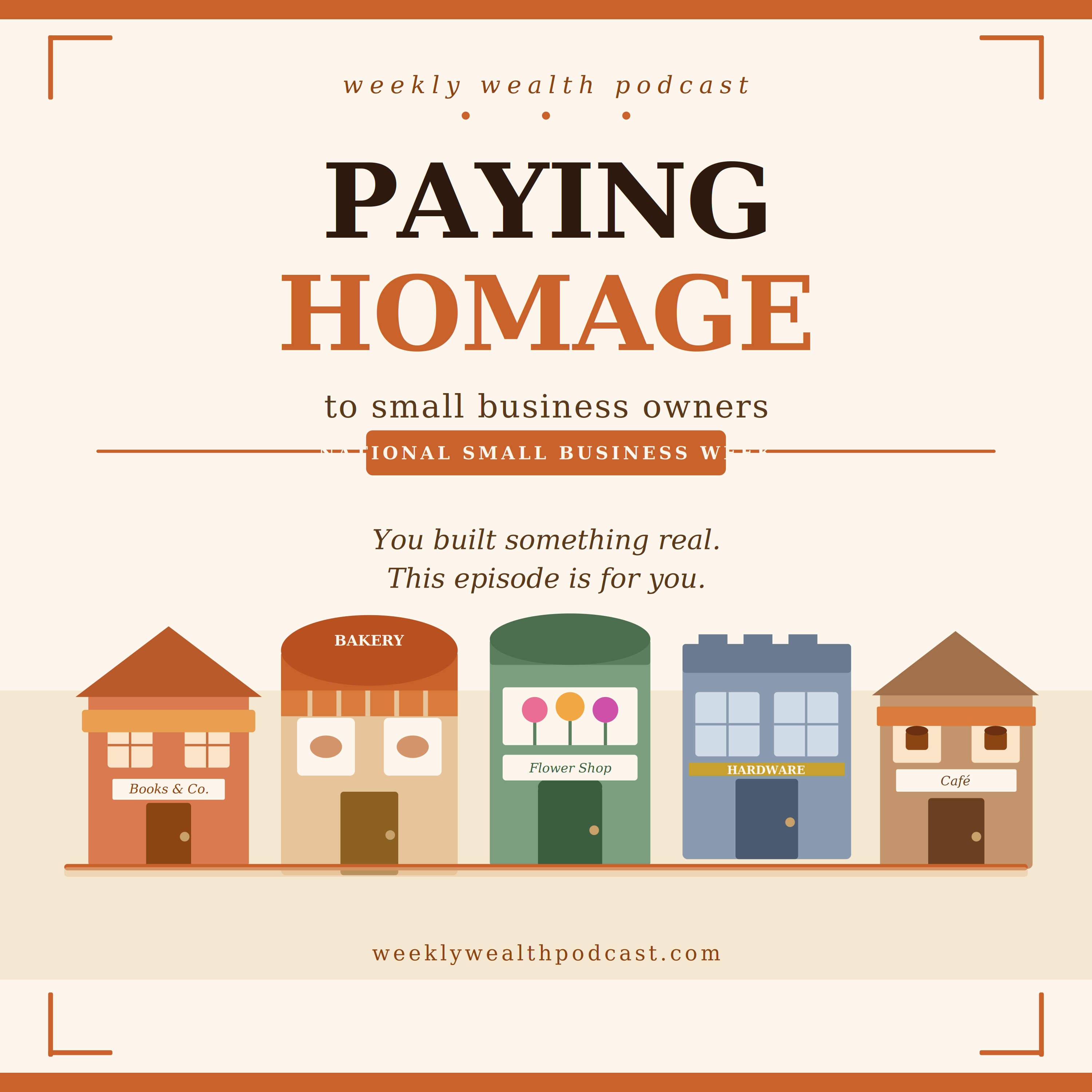
Ep 266: Paying Homage to Small Business owners during National Small Business Week

 Apple Podcasts
 Spotify
 Castro
 RSS Feed
 This week is National Small Business Week — and before we get into strategy, David takes a moment to do something he thinks doesn't happen nearly enough: genuinely honor the people who build and run small businesses in America. Because it's hard. Really hard. And the numbers tell a story that most press releases never will.
Then, in true Weekly Wealth fashion, he makes the turn: Small Business Week celebrates the business. But nobody's talking about the owner's financial future. This episode fixes that.
🎙️ In This Episode
David walks through five financial conversations that almost nobody is having with small business owners right now — and at least one of them is probably going to hit close to home.
#1 — Your CPA Is Only Looking in the Rearview Mirror
There's a big difference between tax preparation and tax planning. Your CPA records history. A real financial strategy looks forward. For most business owners, nobody is having the proactive tax conversation — and it's costing them tens of thousands of dollars a year they don't have to pay.
#2 — Your Business and Personal Finances Are One Big Knot
Mixed accounts. Inconsistent owner pay. No clean separation between what the business earns and what you personally spend. This isn't just messy — it makes it impossible to know your real number. And if you don't know your number, you can't plan. There's even a name for the trap many business owners fall into: busy broke — fully booked, running ragged, and still wondering where the money went at the end of the month.
#3 — Your Business IS Your Retirement Plan
"I'll sell the business someday" is not a retirement strategy. Most businesses don't sell for what the owner thinks they're worth. Some don't sell at all. Your business is a single, illiquid asset — and that concentration risk needs to be managed, not hoped away.
#4 — You're Underinsured in Ways You Don't Even Know
General liability and property coverage are just the beginning. What about disability insurance for you, the owner? Key person life insurance? A properly funded buy-sell agreement? Business insurance isn't set-it-and-forget-it. If you haven't had a real review in the last two to three years, there are likely gaps you don't know about.
#5 — You Have No Exit Strategy
Not having an exit plan doesn't mean you'll stay forever — it means you'll leave on someone else's terms. The business owners who get the best outcomes are the ones who started planning five or ten years out, not the ones who woke up ready to be done and scrambled. What does your exit look like?
📊 Small Business by the Numbers
- 34 million small businesses in the U.S. — 99.9% of all businesses in the country
- 61 million Americans are employed by small businesses — nearly half the private workforce
- Small businesses have created more than 12 million net new jobs over the last 25 years
- 1 in 5 small businesses won't survive their first year. About half are gone by year five. Nearly two-thirds by year ten.
- 82% of small business failures are tied to cash flow problems
- The median small business owner pays themselves about $57,600/year — half make less than that
- The bottom 10% of small business owners make $36,000 or less per year
- 1 in 3 small business owners cut their own salary in the last year to keep the business running
🔗 Resources Mentioned
📋 Sellability Score (Free Assessment)
Find out what your business is actually worth to a buyer — and what you can do to change that number. Scores your business across 8 key value drivers. Free. Takes about 15 minutes.
👉 weeklywealthpodcast.com/sellabilityscore
📅 Book a Vision Call with David
A real conversation about your financial picture — where you are, where you want to be, and what the gap looks like. No pressure. No pitch. Just clarity.
👉 weeklywealthpodcast.com/vision
🎧 Related Episode
Episode 264 — "Is Your CPA Only Looking in the Rearview Mirror?" — David's deep dive on the difference between tax prep and tax planning, and what proactive strategy actually looks like.
💬 Quotable Moments
"Small Business Week celebrates the business. Nobody's celebrating the owner's financial future."
"That's not a business decision. That's a sacrifice. That's someone who loves what they built so much, and cares so much about the people around them, that they'll personally absorb the hit before they'll let anyone else feel it. I think that is genuinely heroic."
"You can be busy broke. Slammed, exhausted, fully booked — and still not making real money because your pricing doesn't reflect your true costs, your time, or your value."
"Your business is an asset. But it's a single, illiquid asset. That's a risk that needs to be managed, not hoped away."
"Planning your exit is the most optimistic thing you can do. It means you believe the business has value worth capturing."
"Nobody's asking whether you're building wealth — or just building a job with a really complicated org chart."
👤 About David Chudyk
David Chudyk, CFP®, CLTC is the founder of CFSIG and a fiduciary financial advisor with Parallel Financial. He works with business owners, high earners, and families who are serious about building — and protecting — real wealth. He is also a Certified ValueBuilder Advisor, helping business owners understand what their company is truly worth and how to maximize it.
📍 Based in Seneca, SC | Serving clients throughout the Southeast and beyond
The Weekly Wealth Podcast is produced by Parallel Financial LLC, a registered investment adviser. This podcast is for informational and educational purposes only and should not be construed as personalized financial, tax, or legal advice. Past performance is not indicative of future results. Please consult with a qualified professional before making any financial decisions.
00:00 - Untitled
00:00 - Celebrating Small Business Heroes
03:09 - Understanding the Challenges of Small Business Ownership
04:25 - Understanding Small Business Challenges
09:45 - Understanding Business Finances and Retirement Planning
14:19 - The Importance of Business Culture
17:51 - Navigating Business Challenges: The Importance of Community
For more than 60 years, the U.S. small Business Administration has celebrated National Small Business Week, which acknowledges the critical contributions of America's entrepreneurs and small business owners.
Speaker ASo on this week's episode, we're going to talk about why the small business owners of the world are heroes, talk about some of their struggles, and talk about some of the things that they need to be thinking about as they're running their businesses.
Speaker ASo I hope that you enjoy this episode.
Speaker AWelcome to the weekly wealth podcast.
Speaker AI am certified financial planner David Chudick.
Speaker AThis podcast and my wealth management practice are both designed to help the mass affluent to live better lives by how they handle their money.
Speaker AWe talk about financial strategies, prosperous mindsets, and simply how to build true wealth.
Speaker ASo come on and let's enjoy this journey together.
Speaker AI want to do something a little bit different today.
Speaker AI want to start this episode by just saying thank you.
Speaker AThis is Small Business Week, and I know what that usually looks like.
Speaker AIt's press releases, some ribbon cuttings.
Speaker AThere's going to be some LinkedIn posts about hustle and grit, and that's fine.
Speaker ABut I want to do something more than that.
Speaker AI want to actually stop and say what I think doesn't get said nearly enough.
Speaker AIf you own a small business, if you've built something, if you're running something, if you're fighting every single day to keep something alive, I see you.
Speaker AI hear you.
Speaker AI am one of you, and I want you to hear this.
Speaker AWhat you do is hard.
Speaker AReally hard.
Speaker ANot, quote, long hours hard.
Speaker ANot, quote, stressful week hard.
Speaker AI mean, the kind of hard that most people will never understand because they've never done it.
Speaker AYou're the CEO.
Speaker AYou're the janitor.
Speaker AYou're the visionary.
Speaker AYou're the person who answers the phone when the Vendor calls at 7am you carry the payroll, the insurance, the taxes, the customers, the employees, the equipment.
Speaker AAll of it in your head every single day.
Speaker AYou don't clock out.
Speaker AYou don't get to leave the office.
Speaker AIt comes home with you.
Speaker AIt wakes you at 3am it's the last thing you think about before you fall asleep.
Speaker AAnd here's what the numbers say about people brave enough like you, brave enough like me to try this.
Speaker AThere are 34 million small businesses in the United States right now.
Speaker A34 Million.
Speaker AThat's 99.9% of every business in this country.
Speaker AAnd Those businesses employ 61 million Americans, nearly half of the entire private workforce.
Speaker AOver the last 25 years, small businesses have created more than 12 million net new jobs in this country.
Speaker ANot the Fortune 500.
Speaker ANot Wall street, just people like you deciding to build something and bring others along with them.
Speaker ABut here's the thing about those 34 million businesses.
Speaker AAbout one in five won't make it past their first year, half won't see year five, and nearly two thirds will be gone by year ten.
Speaker AThose aren't just statistics.
Speaker AEvery one of those is a person who bet on themselves, who gave everything they had, and who, for one reason or another, couldn't make it work.
Speaker AIt's not failure, it's courage.
Speaker AMost people never even try try.
Speaker AWhat about the ones who do make it?
Speaker ALet's talk about what it actually pays.
Speaker ABecause a lot of people think, hey, if your name is on your sign or if your name is on the door, you are bringing home a lot of money.
Speaker AWell, the median small business owner in 2025 took home about $57,600 in that year.
Speaker AThat's the midpoint.
Speaker AHalf of all small business owners made less, half of all made more.
Speaker ABut the bottom 10%.
Speaker AYeah.
Speaker A$36,000 A year for someone who's the owner, the operator, the decision maker, the risk taker.
Speaker A$36,000.
Speaker AAnd that's with a lot of risk, too.
Speaker AAnd it gets more real than that.
Speaker AIn the last year alone, nearly one in three small business owners cut their own salary, not their employees salaries, not their own, to keep the business running.
Speaker AThey made payroll, they kept the lights on, they paid everybody else first.
Speaker AAnd they quietly took less for themselves or nothing at all because that's what it took to keep the doors open.
Speaker AThat's not a business decision.
Speaker AThat's a sacrifice.
Speaker AThat's someone who loves what they built so much and cares so much about the people around them that they'll personally absorb the hit before they let anyone else feel it.
Speaker AI think that is genuinely heroic, and I don't use that word lightly.
Speaker AAnd here's one more thing I want to say before we get into the episode.
Speaker AToday, a lot of small business owners struggle financially.
Speaker ANot because they're bad at their craft, they're usually exceptional at their craft, but because nobody ever taught them the money side.
Speaker AHow to price their work, how to manage cash flow, how to think about building personal wealth alongside the business, how to plan for the day they eventually want to walk away.
Speaker AThat's not a character flaw, that's a gap.
Speaker AAnd exactly the gap I spend my career trying to close.
Speaker ASo this episode is for you, the business owner.
Speaker AI'm one of you.
Speaker AI love you.
Speaker AThe business owner who's been heads down building Something real this week is for you.
Speaker AYou.
Speaker AYou have earned it.
Speaker AOkay, so let's get into the meat of the episode, but before we do, make sure you're doing all the things.
Speaker ACheck out our YouTube page, check out our Facebook page, and also check out our Instagram content.
Speaker AWe're doing the best that we can to provide value to the world.
Speaker AAnd like I always say, I believe that how we handle our money should positively impact our lives and the lives of those around us.
Speaker AAnd I hope that this podcast and our social media content can be a little piece of that puzzle in your life.
Speaker AAnd don't forget, what I provide is the intersection of wealth management, the intersection of business strategy, and the intersection of risk management.
Speaker ASo these are three areas that all of the business owners of the world need to be looking at.
Speaker AAnd we talk about a lot of those things on the weekly wealth podcast.
Speaker ASo let's talk about a few things that a lot of the business owners and a lot of the entrepreneurs of the world are not talking about or nobody's talking to them about.
Speaker AAnd that's because they're busy.
Speaker AIt's because they're dealing with staffing issues, dealing with all of the problems that business ownership brings.
Speaker ASo the first one is that your CPA typically is looking in the rearview mirror.
Speaker AAnd if you remember episode 264, just a few weeks ago, we talked about this.
Speaker ASo I won't get into it in too much depth, but your cpa, your tax preparer, is a historian.
Speaker AThey're typically exceptionally good at recording what happened.
Speaker AThey file your return, they keep you compliant, and they make sure the IRS isn't knocking at your door.
Speaker ASo God bless them for that.
Speaker ARight, because none of us need the IRS knocking at our door.
Speaker ABut proactive tax planning, that's a different conversation.
Speaker AAnd for most business owners, nobody's having it.
Speaker ASo how much are you actually paying in taxes?
Speaker AAdd up your federal, state, self employment, a lot of business owners have 30, 40, and maybe 50 cents on every doll.
Speaker AAnd the scary part is sometimes it doesn't need to be that high.
Speaker ASo between the right entity structure, qualified retirement plans, depreciation strategies, if you've got kids, sometimes you can pay them legally and tax efficiently.
Speaker ASo lots of different tax strategies out there.
Speaker ATax planning isn't about cheating the system, but it's also about not donating more than you have to.
Speaker AAnd one of the principles of tax planning is making sure that we're paying taxes when they will be at the lowest possible rate.
Speaker ASo sometimes paying taxes now and having a tax Free account later on makes a lot of sense.
Speaker ASometimes getting the tax break now and paying taxes on the money, on the distribution makes a lot of sense.
Speaker AAnd this is where the tax planning piece of the puzzle comes into play.
Speaker ANow, another thing that a lot of our business owners are not talking about and are not doing properly, and that's like they have their business and personal finances in one big knot.
Speaker ASo show of hands here, raise your hand.
Speaker AWell, maybe not if you're driving, but how many business owners are running personal expenses through the business?
Speaker AHow many are paying themselves inconsistently?
Speaker AOr how many are just not sure what you're actually making in a given year?
Speaker ASo this is way more common than anyone wants to admit, and it creates a cascade of problems.
Speaker AYou can't accurately read your business's profitability.
Speaker AYour personal financial plan is based on shaky numbers.
Speaker AIf you ever want to sell or bring in a partner, the buyer's due diligence is going to make this very uncomfortable very quickly.
Speaker AThe fix is not complicated, but it requires discipline, Separate accounts, a consistent owner's salary, or draw a clean record of what the business produces versus what you personally spend.
Speaker AWhen your personal and business finances are intertwined, you don't really know your number.
Speaker AAnd if you don't know your number, you can't plan.
Speaker ASo I talk to businesses all the time, small businesses, bigger businesses, and they'll say something like, I made $10,000 last week or I made $500 on that sale.
Speaker AAnd the real way that you should frame that is not that I made.
Speaker AIt should be that the business brought in X amount of revenue.
Speaker AAnd then of course, from that revenue, you have expenses and a small portion of it hope, hopefully will flow through to the business owner in the form of profit.
Speaker AMake sure that you're not confusing business revenue with profit, because they're not the same thing.
Speaker ARevenue minus expenses is profit.
Speaker ARevenue in itself is just a number.
Speaker AAnd in theory, you can have a whole lot of revenue and still not have profit.
Speaker ANow, here's another mistake, and here's another thing that a lot of people are not talking about who are business owners, and that is that your business is your retirement plan.
Speaker AAnd this is a big one.
Speaker AAnd I talk to business owners all the time who have most of their net worth tied up in their business.
Speaker AAnd when I ask what their retirement plan is, they say some version of, I'll sell the business.
Speaker AOkay, but have you thought about what it would actually sell for?
Speaker AHave you had it valued?
Speaker ADo you know what drives the value?
Speaker AAnd whether you're actively building those things.
Speaker ABecause here's the uncomfortable truth.
Speaker AMost businesses don't sell for what the owner thinks they're worth.
Speaker ASome don't sell at all.
Speaker AAnd businesses that are entirely dependent on the owner's relationships, skills and presence, those are the hardest to sell because buyers know the value walks out the door with you.
Speaker AThis is exactly why I use something called the Sellability Score with business owner clients I work with.
Speaker AIt's a free assessment that scores your business across eight drivers that actually move the needle on what a buyer would pay.
Speaker AConcentration, risk, recurring revenue systems that runs without you.
Speaker AI'll put the link in the show notes and if you haven't done this, it should be your homework this week.
Speaker ASo go to www.weeklywealthpodcast.com sellabilityscore.
Speaker AIt's free, it's 15 minutes and it's eye opening.
Speaker AYour business is an asset, but it's a single illiquid asset.
Speaker AThat's a risk that needs to be managed, not hoped away.
Speaker ANow another mistake or another topic that a lot of people are not talking about is risk management and underinsurance.
Speaker ARemember, I wear two hats.
Speaker AI'm a certified financial planner.
Speaker AI run a wealth management practice.
Speaker ABut I also own a proper casualty insurance agency.
Speaker AAnd I can tell you one thing.
Speaker ABusiness owners are chronically and often dangerously underinsured.
Speaker AAnd it's not always the obvious stuff.
Speaker AMost people have general liability, but they have property coverage and maybe there are gaps in less visible places.
Speaker ASo maybe do you have disability coverage?
Speaker ANot on your employee group Plan your coverage as the owner because if you get hurt and can't work for six months, who runs the business?
Speaker AWho pays the bills?
Speaker AAnd your health insurance pays the hospital bills.
Speaker AThis does not pay your mortgage.
Speaker ADo you have key person life insurance?
Speaker AIf you have a business partner, do you have a buy sell agreement funded by life insurance?
Speaker ABecause without it, if your partner dies tomorrow, you might be in business with their spouse who knows nothing about the business and who has opinions that you may not agree with.
Speaker ABusiness insurance is not a set it and forget it thing.
Speaker AYour business changes.
Speaker AYour risk changes.
Speaker AIf you haven't had a real review of your coverage in the last two or three years, it's worth a conversation.
Speaker ASo here's something that a lot of business owners may not think about.
Speaker ALet's say you send one of your team members to the bank.
Speaker AThey're driving their own car.
Speaker AThey're on company time.
Speaker AThey go to the bank to make the daily deposit, right?
Speaker ASo while they're doing this, maybe they Run a stop sign and they cause somebody else to have a grave injury.
Speaker AThey cause major property damage.
Speaker AMajor bodily injury damage.
Speaker AWell, typically, and it may vary in some states, but typically the employees are.
Speaker ACar insurance would be primary, which means that it's going to pay for damages first.
Speaker ANow, if the damages exceed the amount of insurance that the employee is carrying, well then the person that got hurt is going to sue the business.
Speaker AAnd the business owner is really going to hope that they have non owned auto coverage somewhere on one of their business policies.
Speaker AAnd the reason that they would want non owned auto coverage is because somebody who is driving a vehicle that was not owned by the business caused a loss.
Speaker ASo I bet you may not have ever thought about that possibility.
Speaker AAnd I have a lot of other scenarios that can potentially be crippling to the business owners.
Speaker ASo we can't talk about all of the ways that business owners might be underinsured or under protected, but I want you to work with a great local independent insurance agent and ask them, what are my exposures?
Speaker AAnd tell me how to transfer the exposures.
Speaker AAnd sometimes it makes sense to not transfer the exposures and just retain the risk yourself.
Speaker ABut you need to do all these things purposefully and just not by default.
Speaker AHere is the last thing that I want you, the entrepreneur, I want you, the business owner, to be thinking about.
Speaker AAnd actually how about talk about this with your other business owner friends.
Speaker AAnd that is your organizational culture.
Speaker ASo do you have a culture of excellence?
Speaker ADo you have a culture that says we are going to find a way?
Speaker AAnd quite frankly, it is your job as the business owner, as the entrepreneur, to set the culture and make sure that everybody within your organization fits into that culture.
Speaker ASo maintaining culture is one of the most important jobs of the business owner.
Speaker AIt's one of the most important jobs of the entrepreneur.
Speaker ABut nobody really teaches you how to do it.
Speaker ASo it's really leadership, right?
Speaker AIt's how do you lead your people, how do you set expectations?
Speaker AAnd what are the behaviors that are acceptable within your organization?
Speaker AAnd what are the behaviors that are not acceptable within your organization?
Speaker AWhat are the attitudes, what are the thought processes?
Speaker AWhat are all of those things that help your business to be what it is?
Speaker ASo make sure that you're defining your culture, make sure that you're protecting your culture and make sure that anybody who is attempting to change the culture or having a negative effect on the culture, make sure that it's being dealt with.
Speaker ANow it doesn't mean you have to fire somebody right away, but yes, there will be people that just don't fit into your business culture and ultimately that, that's something that needs to be dealt with.
Speaker AAnd there may be times where you go through different seasons where you may have had some team members that aligned with your culture and for whatever reason, maybe at another point they no longer align.
Speaker ASo doesn't mean you're a bad person if you don't fit within the culture anymore.
Speaker ABut protecting the culture of a business is one of the most important jobs of the business owner.
Speaker AAnd I want to finish up talking a little bit about comparison.
Speaker AAnd as a business owner, as an entrepreneur, it can be lonely and oftentimes it can feel like everybody else is succeeding except for you.
Speaker ASo I was recently at a conference and met a business coach, this was an exit planning conference and had dinner with, with, with a guy, I'll never see him again, but he was a good dude.
Speaker AAnd, and we were talking about business ownership and leadership and all of these things because I geek out on these things.
Speaker AAnd I told him that, you know, I, I need to improve my business ownership skills and my leadership skills and, and I said, you know, I think I've always been really good at my trade, but maybe I've not been the greatest business owner.
Speaker AAnd he said something and it was, it was almost loving and caring.
Speaker AHe said, yeah, but compared to what?
Speaker ARight?
Speaker AHe said, can you put your head on your pillow at night and sleep and know that you treated people honestly?
Speaker AWell, yes, maybe to a fault.
Speaker AIt's like, how long have you been in business?
Speaker A21 Years.
Speaker AWell, he's like, you survived way longer.
Speaker AAnd what he said was, don't compare yourself to others.
Speaker ADon't compare yourself to what you think is the truth.
Speaker ANow, as a financial advisor, I work with business owners and I know that very many other business owners, they may look like they have a lot of money, they may look like they're doing more sales than we are, but oftentimes it isn't the case.
Speaker AThere are times also where maybe the business owner, they are successful based on revenue and profit numbers, but maybe also they paid too big of a price as far as spending too much time away from their family and maybe not being a good dad.
Speaker ASo here's what I'm asking you.
Speaker ABuild a community of like minded business owners.
Speaker AI'm in a mastermind group of Christian businessmen and we get together once a month and we just talk about issues and problems and challenges and goals and, and how to build the kingdom with our businesses.
Speaker ABut get together with business owners and talk about the things that are important, but don't compare yourself, all right?
Speaker AYou never know.
Speaker AA lot of times what you see in others is their highlight reel, and you're always comparing your slumps to their highlight reel.
Speaker ATrust me when I tell you that every business, every business goes through slumps.
Speaker AEvery business has vulnerable periods.
Speaker AEvery business has times where maybe their staff is not what it should be.
Speaker AEvery business has time where revenue is tight.
Speaker ASo if you're going through one of those times, and if you even just want to Talk, email me davidarallelfinancial.com let's just talk about business a little bit and if I can ever offer you some encouragement, I would love to do so.
Speaker ABecause trust me, I've been there, it's happened.
Speaker ASo that'll do it.
Speaker AIf you've ever wondered what it might be like to work with me personally as your financial advisor, let's have a Talk.
Speaker AGo to www.weeklywealthpodcast.com Vision Schedule your 10 minute vision call.
Speaker ALet's talk about one or two of the financial issues that are keeping you up at night.
Speaker AI'll do my best to point you in the right direction.
Speaker AIf there are any next steps, we can talk about those and if not, we can say that we can tried and we gave you some direction.
Speaker ASo until next episode, I wish everybody a blessed week and take care of your people and do what you can for the world.
Speaker BThe information presented on this podcast is for general educational purposes only and does not constitute financial investment, legal or tax advice.
Speaker BParallel Financial is registered with the U.S. securities and Exchange Commission SEC as a registered investment advisor.
Speaker BRegistration does not imply a certain level of skill or training, nor does it constitute an endorsement by the sec.
Speaker BAll investing involves risk, including the potential loss of principal.
Speaker BPlease consult a qualified financial professional before making any financial decisions.
Speaker AAnd here is this week's bonus content.
Speaker AAnd I want to reiterate.
Speaker ARemember, you're not alone.
Speaker ABusiness ownership is hard.
Speaker AEntrepreneurship is hard.
Speaker ASo align yourself with a great a great support group and don't compare yourself with others.
Speaker AYou don't want to compare your slumps with anybody else's highlight reels.
Speaker AAnd remember, everybody goes through challenging periods.
Speaker AAll right everybody, until everybody until next episode.
Speaker AI wish everybody a blessed week.
Speaker AThanks.